Breach of Enclosure;
Primary Definition
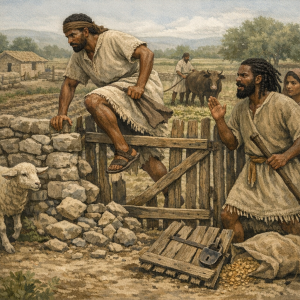
The expression describes an unauthorized breaking, crossing, opening, penetration, or violation of a boundary that law or custom recognizes as protecting a place, possession, or protected interest. In its most historically grounded legal sense, it refers to an invasion of another person’s close—that is, land in that person’s possession—and is closely associated with the common-law action of trespass quare clausum fregit, meaning “why he broke the close.”
An “enclosure” need not be a literal fence, wall, gate, hedge, or ditch. Common law treated the rightfully possessed parcel as though it were surrounded by an invisible legal boundary. John Bouvier explained that whenever one person has a right to exclude another from land, the law effectively encircles the land with an imaginary fence and treats an unauthorized passage across that boundary as an injury to possession.
The expression may therefore identify several related events:
- physically entering land without consent or other legal privilege;
- causing an object, animal, substance, or third person to enter another’s land;
- remaining after permission to occupy has expired or been revoked;
- exceeding the geographical or purposeful limits of permission to enter;
- damaging or opening a physical fence, wall, gate, hedge, or other barrier;
- interfering with a legally established boundary or boundary marker; or
- in interpretive usage, violating the protected integrity of the human body.
The last usage requires qualification. Bodily integrity is firmly protected through doctrines such as battery, assault, informed consent, constitutional protections, and criminal statutes. Nevertheless, describing an unauthorized bodily contact or penetration as a violation of an “enclosure” is primarily an analogy or interpretive formulation. It is not ordinarily the formal name of a separate cause of action in modern American law.
Etymology and Origin
Breach descends from Old English bryce, meaning a fracture or act of breaking. It is related to the verb break and was influenced by Old French breche, meaning a gap or opening. The word developed both a physical meaning—an opening made in a wall, defense, or barrier—and a juridical meaning, as in a breach of covenant, duty, trust, peace, or law.
Enclosure, historically also written inclosure, came into English through forms related to Old French enclore, “to surround, confine, or contain,” ultimately associated with Latin words for shutting or closing. By the fifteenth century, enclosure could denote both the act of enclosing and the bounded place created by that act.
The combination of the words naturally signifies a breaking of what surrounds or protects something. In military language, a breach is an opening made in a defensive wall or fortified position. In property law, however, the decisive “wall” may be legal rather than material. The protected boundary arises from possession and the right to exclude, not merely from construction of a visible barrier.
Cultural and Historical Context
The Close and the Agricultural Landscape
In older English legal usage, a close was land separated or treated as separated from surrounding land. It might be bounded by hedges, fences, walls, ditches, natural features, or recognized lines. The writ of trespass quare clausum fregit alleged that the defendant had broken the plaintiff’s close. The formula did not necessarily accuse the defendant of smashing a gate or cutting a fence. It alleged an unjustified invasion of land in the plaintiff’s possession.
This legal conception developed in an agricultural society in which boundaries determined who could cultivate crops, pasture animals, gather resources, or exclude strangers. A damaged hedge could allow livestock into grain or gardens, producing losses far beyond the cost of repairing the barrier. Historical disputes therefore involved not only human entry but wandering animals, destroyed crops, altered landmarks, blocked ways, and failures to maintain fences.
Distinction from the Enclosure Movement
The expression should not automatically be equated with the English Enclosure Acts or the broader enclosure movement. They share the vocabulary of bounded land but identify different legal and historical questions.
Beginning in the medieval period and accelerating during the eighteenth and nineteenth centuries, enclosure consolidated open fields and lands subject to common rights into separately held parcels. Parliamentary legislation became an important mechanism for this process. According to the United Kingdom Parliament, more than 5,200 enclosure bills relating to approximately 6.8 million acres were enacted between 1604 and 1914. Enclosure awards and maps redistributed land, defined boundaries, established roads, and furnished evidence of title and rights.
Supporters regarded consolidation as a means of improving agricultural efficiency, investment, drainage, and crop management. Critics emphasized the loss or reduction of customary rights, the expense imposed upon small holders, social displacement, and the concentration of land and political power. Historians continue to debate the degree to which enclosure caused rural poverty, migration, and the formation of a landless wage-laboring population.
A violation of a particular enclosed parcel is thus a matter of trespass or boundary interference. The historical enclosure movement concerns the creation and redistribution of exclusive rights themselves. One protects an established boundary; the other raises the prior question of how that boundary and the rights behind it came into existence.
Military and Defensive Usage
A military breach is an opening made in a wall, perimeter, or defensive line so that forces may enter. This physical sense helps explain the legal metaphor, but the property-law expression is not ordinarily a distinct military offense. Unauthorized entry into a military installation may instead be governed by criminal trespass laws, security regulations, military orders, espionage statutes, or laws concerning restricted federal property.
Biblical / Torah Context
The exact English legal expression is not a technical term of the Torah. Biblical law nevertheless contains principles concerning boundaries, fields, restitution, and the integrity of another household’s inheritance that closely parallel the underlying idea.
Deuteronomy 19:14 prohibits moving a neighbor’s ancient boundary marker within the inherited land. Deuteronomy 27:17 pronounces a curse upon the person who moves such a landmark. These commands address more than damage to a stone. Secretly relocating a marker could appropriate part of another family’s inheritance while creating false evidence of the new line. Proverbs 22:28 and 23:10 similarly warn against removing ancient landmarks, particularly where vulnerable persons could be dispossessed.
Exodus 22:5 provides that a person who allows livestock to stray and graze in another person’s field or vineyard must make restitution. This is a direct ancient example of responsibility for causing animals to cross a protected agricultural boundary and consume another’s produce. The rule concerns the resulting invasion and loss, whether the animal entered through an opening, inadequate supervision, or deliberate release.
Torah law also complicates any claim that ownership confers unlimited dominion. Leviticus 19:9–10 commands landholders not to reap to the extreme edges of their fields and to leave gleanings for the poor and the foreigner. Deuteronomy 23:24–25 permits limited consumption from a neighbor’s vineyard or standing grain while forbidding the visitor from carrying produce away or harvesting it with a sickle. These provisions recognize ownership and boundaries while placing moral and covenantal limitations upon absolute exclusion.
Accordingly, the biblical pattern includes several principles: respect established boundaries, do not enlarge one’s possession through fraud, control what one sends onto another’s land, repair measurable injury, protect inherited holdings, and remember that property remains subject to duties of mercy and justice.
Legal Implications
Historical Common Law
At historical common law, trespass to land protected possession rather than title in the abstract. A tenant or other person in lawful possession could generally sue an intruder even if someone else held ultimate ownership. The central injury was the direct and unauthorized interference with the possessor’s exclusive control.
Every unjustified physical entry could support an action even when the defendant caused no measurable destruction. The law presumed at least nominal injury from the violation of possession. This rule prevented repeated unauthorized entries from ripening into practical domination merely because each individual entry caused little financial loss.
The traditional action differed from ejectment, which determined rights to possession and recovered land from one withholding it, and from an action on the case, which commonly addressed indirect or consequential injuries. The procedural divisions have largely disappeared, but their concepts survive in modern distinctions among trespass, nuisance, negligence, encroachment, and actions to determine title or boundaries.
Modern Trespass to Land
Although state law varies, modern civil trespass commonly requires an intentional physical entry upon land possessed by another without consent or legal privilege. “Intentional” ordinarily means that the defendant intended the act that resulted in entry; it does not always require knowledge that the land belonged to someone else. A mistaken belief concerning the property line may therefore fail as a defense to civil liability.
Entry may occur when a person:
- walks or drives across the boundary;
- throws, deposits, or directs a tangible object onto the premises;
- causes another person or an animal to enter;
- places a structure over the line;
- enters below the surface or within protected low-altitude airspace;
- refuses to leave after authority to remain has ended; or
- fails to remove an object when under a duty to remove it.
No physical fence is universally required. Fencing, signs, gates, surveys, and recorded descriptions can prove notice or locate the disputed line, but the legal right does not arise solely from those objects. Criminal trespass is different and is usually defined by statute. It may require notice, knowledge, refusal to depart, entry into a specified type of property, or a particular state of mind not required for the civil tort.
Remedies
Available civil remedies may include nominal damages for the invasion itself, compensatory damages for physical injury or loss of use, restoration costs, recovery of profits in appropriate cases, punitive damages for malicious conduct, and an injunction against repeated or continuing entry. Boundary disputes may also require declaratory relief, a quiet-title action, ejectment, or removal of an encroaching structure.
A continuing obstruction or structure may generate recurring liability, but jurisdictions differ in how they classify permanent and continuing trespasses and when limitation periods begin. Statutes may also authorize enhanced damages for cutting timber, damaging crops, or destroying boundary monuments.
Consent, Necessity, and Other Privileges
An entry is not wrongful when valid consent or another legal privilege authorizes it. Permission may be express or implied, but it can be restricted by time, place, person, and purpose. A delivery worker may have an implied license to approach the front door; that does not ordinarily authorize entry into a locked outbuilding. A visitor invited for one lawful purpose may become a trespasser by entering a forbidden area or remaining after consent is revoked.
Other possible privileges include public or private necessity, lawful arrest, execution of a warrant, emergency response, inspection authority created by statute, easements, public rights-of-way, and entries required to prevent imminent harm. Necessity does not invariably erase responsibility for actual damage. The precise result depends upon the nature of the emergency and the governing jurisdiction.
Government Entry and Constitutional Law
Government officials are not automatically exempt from boundaries. Their authority must arise from a warrant, statute, recognized common-law privilege, consent, emergency doctrine, or other lawful source. The historic decision in Entick v. Carrington became a major statement against executive officers entering and searching private premises without lawful authority.
American constitutional law also retains property-based concepts. In United States v. Jones, the Supreme Court treated a physical government intrusion upon a constitutionally protected “effect” for the purpose of obtaining information as significant under the Fourth Amendment. In Florida v. Jardines, officers exceeded the implied license to approach a home when they physically occupied its curtilage to conduct an investigative search with a drug-detection dog.
The right to exclude also matters under the Takings Clause. In Cedar Point Nursery v. Hassid, the Supreme Court held that a regulation granting labor organizations a formal right to enter agricultural employers’ property constituted a per se physical taking. The Court distinguished such a legally granted access entitlement from an isolated private trespass and from traditional government inspection or emergency privileges.
The Human Body as an Enclosure
Some interpretive legal writing treats the body, with the skin as its natural boundary, as a personal enclosure. Under that analogy, an unauthorized object, instrument, substance, or physical contact crosses a boundary protected by the person’s right to exclude.
The underlying concern is legally substantial, but ordinary doctrine uses other names. Intentional harmful or offensive contact without consent is generally addressed as battery. Threatened imminent contact may constitute assault. Unauthorized medical treatment may support battery, while inadequate disclosure of risks is often analyzed under negligence or informed-consent law. In Cruzan v. Director, Missouri Department of Health, the Supreme Court discussed the common-law connection among bodily integrity, unauthorized touching, battery, and informed consent.
It is therefore reasonable to employ enclosure as a moral or explanatory metaphor for bodily integrity. It is inaccurate, however, to assume that merely naming an act a violation of an enclosure creates an independent lawsuit, determines constitutional rights, or overrides statutes governing consent, medical emergencies, guardianship, public health, parental authority, or criminal conduct.
Spiritual Meaning
Spiritually, an enclosure can symbolize the limits that preserve identity, peace, family, conscience, and stewardship. A healthy boundary is not necessarily a declaration of hostility. It may define the area within which a person is responsible and protect what has been entrusted to that person.
A violation of such a boundary may symbolize intrusion, betrayal, domination, or disregard for consent. Repair involves more than closing the visible opening. It may require acknowledgment, restitution, renewed trust, clearer limits, and protection against repetition.
The symbol also warns against treating every enclosure as sacred merely because it exists. Some walls protect life and rightful possession; others conceal injustice or exclude persons whom moral duty requires the holder to assist. Spiritual discernment asks both whether a boundary has been wrongfully crossed and whether the boundary itself is righteous, honest, and consistent with obligations toward one’s neighbor.
Modern Usage
The expression is now uncommon as a formal pleading term. Lawyers usually speak of trespass to land, unlawful entry, encroachment, boundary interference, property damage, unauthorized access, battery, or violation of bodily integrity. It may still appear in historical dictionaries, property discussions, descriptions of damaged environmental or safety barriers, and writings seeking to explain the right to exclude through the image of a protected perimeter.
Outside law, it can describe a broken livestock fence, a ruptured containment system, an opening in a secured installation, or any failure of a barrier intended to confine people, animals, contaminants, or dangerous materials. These technical uses should not be confused with the old common-law action unless an invasion of legally protected possession is also involved.
Controversies / Criticisms
The first controversy is whether the language wrongly suggests that a visible fence is essential. Historical common law answers no: the “close” was a legal conception, and unfenced land could still be trespassed upon. Modern criminal statutes, however, sometimes make fencing or posted notice relevant to proof, so the distinction between civil common law and statutory crime must be maintained.
A second controversy concerns the moral legitimacy of exclusion. Protection of settled possession can preserve security and peaceful order, yet historical boundaries may reflect conquest, dispossession, discriminatory law, or the extinguishment of customary rights. The English enclosure movement demonstrates why enforcement of a boundary and justification of the system that created it are separate questions.
A third controversy concerns expansion of the term to the body. The analogy powerfully expresses consent and personal sovereignty, but it can blur established distinctions among land, persons, chattels, privacy, and constitutional liberty. Courts decide actual claims under recognized causes of action and applicable legislation, not through analogy alone.
Finally, the expression should not be used as a formula that supposedly frees a person from current statutes, court procedure, taxation, licensing rules, warrants, or other valid exercises of public authority. Common law remains important, but it operates within constitutional and statutory systems. The existence of an ancient maxim does not by itself decide a modern dispute.
Conclusion
The concept expresses a foundational common-law principle: a protected boundary has legal meaning, and unauthorized physical invasion may be actionable even when no substantial damage follows. Historically, the enclosure was the possessor’s close, surrounded either by an actual barrier or by the law’s imaginary fence. The concept developed into the modern law of trespass, while related principles influence constitutional protections against government intrusion and the law’s respect for bodily integrity.
Its proper use requires attention to context. A broken fence, an entry upon land, relocation of a boundary marker, unauthorized bodily contact, and a government inspection may all involve boundaries, but they are governed by different legal doctrines. The enduring lesson is not that every boundary is absolute. It is that entry requires lawful justification, permission must be respected within its limits, injury calls for an appropriate remedy, and both private rights and public authority remain accountable to law.
Sources / Further Reading
- John Bouvier, Bouvier’s Law Dictionary, 1856 edition, entry concerning “Close”: https://constitution.org/1-Constitution/bouv/bouvier_c.htm
- William Blackstone, Commentaries on the Laws of England, Book III: https://oll.libertyfund.org/title/sharswood-commentaries-on-the-laws-of-england-in-four-books-vol-2
- Cornell Legal Information Institute, “Trespass”: https://www.law.cornell.edu/wex/trespass
- Cornell Legal Information Institute, “Battery”: https://www.law.cornell.edu/wex/battery
- American Law Institute, Restatement (Second) of Torts overview: https://www.ali.org/publications/restatement-law-second/torts
- United Kingdom Parliament, “Enclosing the Land”: https://www.parliament.uk/about/living-heritage/transformingsociety/towncountry/landscape/overview/enclosingland/
- The National Archives, “Enclosure Acts, Awards and Maps”: https://www.nationalarchives.gov.uk/help-with-your-research/research-guides/enclosure-awards/
- United States v. Jones, 565 U.S. 400 (2012): https://www.law.cornell.edu/supremecourt/text/10-1259
- Florida v. Jardines, 569 U.S. 1 (2013): https://www.law.cornell.edu/supremecourt/text/11-564
- Cedar Point Nursery v. Hassid, 594 U.S. 139 (2021): https://www.supremecourt.gov/opinions/20pdf/20-107_ihdj.pdf
- Cruzan v. Director, Missouri Department of Health, 497 U.S. 261 (1990): https://www.law.cornell.edu/supremecourt/text/497/261
- Bible Gateway, Deuteronomy 19:14: https://www.biblegateway.com/verse/en/Deuteronomy%2019%3A14
- Bible Gateway, Exodus 22:5: https://www.biblegateway.com/passage/?search=Exodus%2022%3A5
- Online Etymology Dictionary, “Breach”: https://www.etymonline.com/word/breach
- Online Etymology Dictionary, “Enclose”: https://www.etymonline.com/word/enclose