Alias et quia th yi
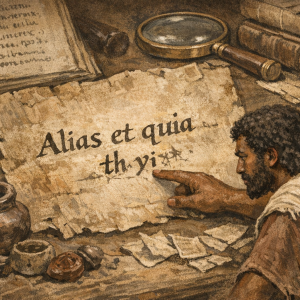
Primary Definition
Editorial classification: an unverified, apparently corrupt or incomplete textual sequence rather than an established Latin maxim, common-law term, biblical expression, or recognized phrase of legal art.
The supplied wording should not be assigned a single authoritative translation without locating the document, manuscript, image, or surrounding sentence from which it came. Three elements resemble ordinary Latin words, while the final characters do not form an identifiable Latin construction. The most responsible definition is therefore:
A fragment containing recognizable Latin particles but lacking sufficient grammatical coherence or textual context to establish a definite meaning.
The identifiable components may be examined separately:
- alias is a Latin adverb meaning, according to context, “at another time,” “on another occasion,” “otherwise,” or “in another manner.” In later English and legal usage, alias became a noun referring to another name by which a person is known.
- et is the ordinary Latin conjunction “and.” It may also join clauses, names, offices, objects, or propositions.
- quia commonly means “because” or “since.” In later and medieval Latin it can also introduce a statement and function approximately as “that,” especially after verbs of knowing, proving, saying, or perceiving.
- The remaining characters do not, as written, yield a recognized Latin word or conventional legal abbreviation. They may represent an incomplete transcription, damaged text, scribal contraction, printer’s artifact, database corruption, or optical character recognition error.
Combining dictionary meanings mechanically would produce something resembling “otherwise and because,” followed by unintelligible material. That is not a reliable translation. Latin meaning depends on syntax, inflection, punctuation, and context; a list of individually translatable words is not necessarily a sentence.
Etymology and Origin
Alias
The Latin adverb alias is associated with alius, meaning “other” or “another.” Classical authors used the adverb temporally or comparatively: “at another time,” “elsewhere in the discussion,” or “otherwise.” Medieval administrators, notaries, and courts continued using it in documents where repetition, alternative descriptions, and renewed commands were common.
English adopted alias through legal and administrative practice. The expression alias dictus, literally “otherwise called,” helped establish the familiar sense of an alternative name. Over time, English speakers treated alias not merely as a Latin adverb but as a noun: “an alias.” This later noun can identify a nickname, assumed name, former name, stage name, spelling variant, or name connected to the same individual in official records.
Et
Et is among the oldest and most common Latin conjunctions. Its basic function is additive, corresponding to English “and.” The ampersand developed historically from a ligature or combined written form of the letters in et. Because the word is so common, its presence does not identify a text as legal, religious, governmental, or philosophical. It appears throughout every major category of Latin writing.
Quia
Quia is a causal and explanatory conjunction. Classical usage ordinarily connects a result, statement, or action with its reason. Late antique and medieval writers broadened its use, sometimes employing it where classical prose might prefer an accusative-and-infinitive construction or another conjunction. Accordingly, a legal or theological passage may use quia to introduce either a reason—“because”—or the content of an assertion—“that.”
Probable Textual Condition
No documented evidence presently establishes the complete sequence as an ancient maxim or technical formula. Its unusual ending makes textual corruption more probable than a previously unknown doctrine. Historical books and manuscripts routinely contain abbreviations, suspended endings, contractions, ligatures, marginal notes, damaged letters, and typefaces that modern readers or software may misidentify.
The National Archives warns that machine-generated optical character recognition is often imperfect and requires comparison with the original image. The Library of Congress likewise notes that medieval manuscripts contain thousands of scribal abbreviations whose expansion depends on the scribe and context. Thus, an electronic search result is evidence of what software extracted, not necessarily of what the source actually says.
Cultural and Historical Context
Latin served for centuries as a language of scholarship, theology, diplomacy, recordkeeping, canon law, Roman-law learning, and portions of English legal procedure. That wide use can create the false impression that every surviving Latin-looking fragment is a maxim carrying special authority. Many fragments are merely connective prose, headings, clerical directions, names, or portions of longer sentences.
English legal records often combined Latin, Anglo-Norman French, and English. Clerks also used standardized abbreviations to conserve writing materials and labor. When such documents were recopied, printed, microfilmed, scanned, or converted into searchable text, errors could enter at every stage. A modern string may therefore be several generations removed from the words written by the original clerk.
Historical interpretation should proceed from the physical or photographic source outward. A sound method asks:
- Where does the wording appear?
- What words precede and follow it?
- Is the source handwritten, printed, or machine-transcribed?
- What century, jurisdiction, and document type are involved?
- Are abbreviation marks visible above or beside the letters?
- Do other copies or editions contain a clearer reading?
- Does the proposed expansion produce grammatical Latin appropriate to the period?
Without these controls, a transcription error may be promoted into a supposed maxim and then repeatedly cited as though it were historical authority.
Biblical / Torah Context
The complete fragment is not a recognized expression from the Torah, the Hebrew Bible, or the New Testament. The Torah’s original language is principally Hebrew, not Latin. Latin wording associated with Torah passages comes from later translations, especially forms of the Vulgate tradition.
The individual word quia appears frequently in Latin biblical translations because biblical narratives, laws, prophecies, and wisdom texts often give reasons for commands or consequences. For example, Latin versions of Genesis use quia in causal statements that may be translated “because you have done this,” “because you are dust,” or “because in it God rested.” These examples establish the ordinary grammatical function of quia; they do not establish a connection between the supplied fragment and any particular verse.
Et is likewise ubiquitous in biblical Latin because it simply means “and.” Alias, by contrast, is not a theological title or central Torah concept. Where a Latin religious text uses it, the word ordinarily retains its grammatical meaning, such as “otherwise” or “at another time.”
No doctrine concerning divine names, covenant identity, hidden identities, or spiritual transformation should be inferred from the appearance of alias alone. Biblical interpretation requires an identifiable passage and comparison with the Hebrew, Aramaic, or Greek source where appropriate.
Legal Implications
Historical Common-Law Usage of Alias
Although the complete wording is not an established common-law term, alias has genuine legal history. In English and American practice, it could indicate that a person was “otherwise called” by another name. This helped courts connect pleadings, warrants, property records, criminal records, and judgments to the correct person despite name variations.
Alias also acquired a procedural meaning in expressions such as alias writ, alias summons, and alias execution. Historically, an alias writ was a second writ of the same general kind issued after an earlier writ had failed, had been returned unserved, or had not fully accomplished its purpose. Bouvier’s nineteenth-century law dictionary described alias as prefixed to the name of a second writ. Some modern state statutes preserve this vocabulary; the precise availability and effect of such process now depend on the governing statute and procedural rules.
Names and Identity in Current Law
Modern courts and agencies use “also known as,” commonly abbreviated “a.k.a.,” to record alternative names. An alias does not necessarily imply fraud or criminality. A person may have a birth name, married name, former name, professional name, transliterated name, nickname, or spelling variant. Context determines whether an alternate name is innocent, evidentiary, misleading, or unlawful.
Conversely, adopting or using another name does not automatically create a separate legal person, erase obligations, defeat jurisdiction, or invalidate a properly identified judgment. Courts generally examine whether the record identifies the actual party and whether any naming error caused prejudice or denied fair notice. Legal consequences arise from applicable law and facts, not from the supposed occult force of Latin terminology.
Roman Law, Canon Law, and Equity
The fragment should not be attributed to Roman law merely because several words are Latin. Roman legal texts contain alias, et, and quia in ordinary prose, but common vocabulary is not proof of a technical Roman-law formula. The same caution applies to medieval canon law and ecclesiastical records.
No distinct equitable maxim corresponding to the complete sequence has been identified. Equity developed its own doctrines, remedies, and maxims, but those principles must be traced to recognized treatises, cases, or institutional practice. A garbled Latin string cannot independently establish an equitable right or defense.
No Self-Executing Legal Effect
The supplied wording, standing alone, creates no demonstrated writ, jurisdictional objection, military command, governmental office, status change, exemption, or private right. A phrase acquires legal force only through a valid source of law or through its operative use in an authentic instrument. Depending on the jurisdiction, relevant sources may include constitutions, statutes, regulations, procedural rules, judicial decisions, recognized customary law, and enforceable agreements.
This distinction is especially important when historical dictionary entries are used in modern disputes. A dictionary records usage; it does not enact law. An obsolete procedural definition may illuminate an old document without describing present procedure.
Spiritual Meaning
There is no documented spiritual teaching uniquely attached to the complete fragment. Any spiritual meaning assigned to it would be interpretive rather than lexical or historical.
At most, the identifiable words may prompt general reflection. Alias can call attention to the difference between a name, a reputation, and the person named. Quia, as “because,” can suggest the moral importance of causes, reasons, and accountability. Et, as “and,” joins matters that might otherwise remain separate. These associations may be useful in meditation or teaching, but they are symbolic applications created by the interpreter. They should not be represented as an ancient doctrine concealed within the wording.
A disciplined spiritual reading respects truthfulness. Where a text is uncertain, acknowledging uncertainty is preferable to inventing revelation. The desire to discover profound meaning should not override grammar, documentary evidence, or the distinction between inspiration and historical fact.
Modern Usage
In contemporary English, alias is the only component likely to stand independently. It is used in several fields:
- Law enforcement and courts: an alternative name linked to a person or record.
- Computing: an alternate command, account identifier, email address, or reference to the same data or resource.
- Literature and entertainment: a pen name, stage name, assumed identity, or fictional cover identity.
- Genealogy and archives: a spelling variant, married name, translated name, or name found in another record.
- Everyday speech: a pseudonym or alternate designation.
The complete sequence has no established modern usage outside apparent reproductions of the same uncertain text. Repetition on websites does not cure the absence of a primary source. If the wording originated in a scan, each copied occurrence may repeat the same initial transcription error.
Controversies / Criticisms
The principal controversy is not a dispute between recognized schools of legal interpretation. It is the risk of treating incoherent or damaged wording as if it were a settled maxim.
One error is the word-by-word fallacy: translating each visible token and assuming the resulting English words express the original author’s intention. This ignores Latin syntax, missing material, case endings, and period-specific usage.
A second error is the Latin-authority fallacy: assuming that Latin wording is automatically ancient, legal, sacred, or binding. Latin was an ordinary working language for many institutions. It could communicate profound doctrine, but it could also record routine procedural details.
A third issue is OCR circularity. Search engines may index defective extracted text. Later writers find the indexed string, copy it into new pages, and then point to those pages as independent confirmation. In reality, all versions may descend from one faulty scan.
There is also a broader legal criticism of attempts to derive present rights from isolated dictionary language. Historical legal dictionaries are valuable evidence of past terminology, but current legal rights ordinarily depend on controlling law in the relevant jurisdiction. Neither unusual capitalization, alternate names, nor unexplained Latin fragments automatically divide a human being from a supposed legal entity or nullify governmental authority. Claims of that kind require actual constitutional, statutory, or precedential support.
Conclusion
The supplied wording is best preserved as an uncertain textual artifact, not promoted into a definite maxim. Its recognizable parts are genuine Latin words with well-established meanings, and alias has an important history in common-law procedure and personal identification. Nevertheless, those facts do not make the entire sequence grammatical or legally operative.
A conclusive interpretation requires the earliest available source, a clear image, surrounding text, and expert comparison of possible abbreviations or printing errors. Until that evidence is supplied, responsible dictionary treatment should distinguish what is known from what is merely possible: alias, et, and quia are identifiable; the complete construction and final characters remain unresolved.
Sources / Further Reading
- Lewis and Short, A Latin Dictionary, searchable edition: https://www.alatius.com/ls/
- Legal Information Institute, Cornell Law School, “Alias”: https://www.law.cornell.edu/wex/alias
- John Bouvier, A Law Dictionary, 1856 edition: https://www.supremelaw.org/ref/dict/
- National Archives, “Transcription Tips”: https://www.archives.gov/citizen-archivist/transcribe/tips
- National Archives, “Get Started Transcribing,” including guidance concerning OCR: https://www.archives.gov/citizen-archivist/get-started-transcribing
- Library of Congress, “Deciphering Scribal Abbreviations”: https://guides.loc.gov/manuscript-facsimiles/deciphering-scribal-abbreviations
- The Holy See, Nova Vulgata: Liber Genesis: https://www.vatican.va/archive/bible/nova_vulgata/documents/nova-vulgata_vt_genesis_lt.html
- Justia Legal Dictionary, “Alias Writ”: https://dictionary.justia.com/alias-writ