Knight
Primary Definition
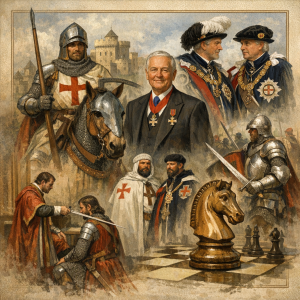
A knight is, in its principal historical sense, a mounted military retainer or warrior who owed service to a lord or sovereign and who, in medieval Europe, came to hold a recognized social and ceremonial rank. In a later and still current British sense, a knight is a person upon whom a sovereign has conferred a knighthood as an honor for distinguished service or achievement. The word may also identify a member of a chivalric, charitable, religious, fraternal, or ceremonial order; a chess piece shaped traditionally as a horse’s head; or, figuratively, a protector, champion, or rescuer.
The term must be used with attention to time and place. A medieval knight was not simply any soldier on horseback, nor was every knight necessarily a hereditary nobleman. Knighthood developed through changing relationships among military service, landholding, royal authority, ceremony, and social rank. A modern knight, by contrast, ordinarily receives an honor rather than a feudal estate, a private military command, judicial authority, or a hereditary right to govern.
Dictionary usage preserves these distinct senses: the historical mounted man-at-arms; the person ceremonially admitted to knightly rank; the person honored by a sovereign; the member of an order or society; and the chessman that moves in an L-shaped pattern. Merriam-Webster records all of these major modern senses. ([merriam-webster.com](https://www.merriam-webster.com/dictionary/knight?utm_source=openai))
Etymology and Origin
The English word developed from Old English cniht, a word whose earlier meanings included “boy,” “youth,” “servant,” “attendant,” and military follower. It is related to West Germanic words including Dutch knecht and German Knecht, words associated historically with a servant, retainer, or dependent. The original English word therefore did not mean “noble horseman” in the later medieval sense. Its history is a significant example of how a term for service or attendance can acquire a specialized military and then honorary meaning. ([oxfordlearnersdictionaries.com](https://www.oxfordlearnersdictionaries.com/us/definition/english/knight_1?utm_source=openai))
By approximately the beginning of the twelfth century, cniht could denote a military follower of a king or superior. In Middle English, forms such as kniht and knyght gradually produced the modern spelling knight. The apparently silent initial k and the letters gh preserve an older pronunciation in which those consonants were sounded. Modern English pronunciation, /nīt/, reflects later sound changes rather than the original spoken form.
The word’s development should not be confused with the origins of cavalry generally. European mounted warriors existed before English knight became a formal rank, and other languages used their own terms. French chevalier, for example, is associated with the horse, while the English term arose from a Germanic word for a youth, servant, or retainer. It is therefore inaccurate to say that knight is etymologically a Roman, Greek, Latin, or biblical word. Ancient Roman equites and Greek horsemen are sometimes called “knights” in English merely by analogy, not because they held the distinct medieval English office or status.
Cultural and Historical Context
Military Service, Land, and Rank
In medieval England and parts of continental Europe, knighthood became associated with mounted military service. A lord might hold land from a superior and owe military assistance in return; persons below him could likewise owe service. The relationship was not uniform across all regions or centuries, and medieval society cannot be reduced to a single neat “feudal pyramid.” Nevertheless, the connection between landholding, military obligation, and lordship was real and legally important in many places.
A knight’s equipment—horse, armor, weapons, retainers, and training—was costly. For that reason, mounted service often corresponded with wealth and landholding. A knight could hold a “knight’s fee,” meaning land assessed for the support or obligation of knightly military service. The surviving text of Magna Carta addresses relief owed by the heir of a knight for a knight’s fee, showing that the status had consequences in the law of inheritance and tenure as well as in warfare. ([archives.gov](https://www.archives.gov/press/press-kits/magna-carta/magna-carta-translation.pdf?utm_source=openai))
By the high Middle Ages, knighthood was increasingly both a military designation and a social dignity. The ceremony of admission commonly involved a vigil, blessing or presentation of arms, the giving of spurs, and “dubbing,” in which a sovereign or other person of rank formally made the candidate a knight. The details varied substantially. The familiar image of a ruler touching a kneeling candidate with a sword reflects one form of ceremony, but it should not be treated as an unchanging rule applicable to every period or kingdom. English Heritage notes the variety and ceremonial importance of medieval preparation, vigil, weapons, spurs, and dubbing. ([english-heritage.org.uk](https://www.english-heritage.org.uk/visit/inspire-me/5-things-you-might-not-know-about-knights/?utm_source=openai))
Chivalry and Literature
“Chivalry” is closely associated with knighthood, but the two words are not identical. Knighthood referred to a status, office, rank, or honor. Chivalry referred more broadly to the ideals, customs, expectations, and literary representations associated with mounted elite warriors. Medieval romances presented the knight as courageous, loyal, generous, devout, self-controlled, and protective of the weak. Arthurian literature, stories of knights-errant, tournaments, crusading narratives, and later romantic fiction strongly shaped the popular image of the knight.
These ideals were aspirational, not a reliable description of every knight’s conduct. Historical knights participated in warfare, land disputes, dynastic struggles, private violence, and systems of social inequality. The ideal of honorable restraint existed beside conduct that modern readers may regard as brutal or exploitative. A dictionary definition should therefore distinguish the cultural ideal of the “chivalrous knight” from the historical reality of armed service within a hierarchical society.
Orders of Knighthood
Over time, monarchs and religious institutions created orders of knighthood. Some medieval military-religious orders combined religious vows, charitable activity, military functions, and international landholding. Later royal orders became principally honors awarded for service. The phrase “knight of” may therefore refer to membership in a particular order rather than to medieval battlefield service.
Modern British usage retains this honorary meaning. The United Kingdom’s official honors system describes the Knight Bachelor as an appointment originating in the medieval period. It grants recipients the title Sir, but it is not itself a royal order and does not carry post-nominal letters. Other orders confer knighthoods or damehoods in recognition of major service in public life, the arts, sciences, charitable work, government, military service, and other fields. ([honours.cabinetoffice.gov.uk](https://honours.cabinetoffice.gov.uk/about/orders-and-medals/?utm_source=openai))
Biblical / Torah Context
The Torah does not establish a class called “knights” in the medieval European sense. Ancient Israelite texts speak of kings, warriors, commanders, chariots, horses, horsemen, guards, and armed men, but these categories should not automatically be translated into the later European institution of knighthood. For example, the Exodus narrative refers to Pharaoh’s horses, chariots, and horsemen; this describes an ancient Egyptian military force, not a feudal or chivalric order. ([sefaria.org](https://www.sefaria.org/Exodus.14.14?with=Midrash&utm_source=openai))
Accordingly, claims that the Torah created medieval knighthood, or that every biblical horseman was a “knight,” are historically unsound. Such language may be used poetically or as a loose English analogy, but it is not a precise legal, linguistic, or institutional translation.
Later Christian thought did influence some European understandings of knighthood. Clerics, rulers, and writers sometimes connected the knightly vocation with duties of faith, defense of the church, protection of pilgrims, keeping oaths, and restraint in violence. Those developments belong to medieval Christian Europe, not to the original legal vocabulary of the Torah. Jewish and Christian readers may draw moral lessons from biblical themes of courage, justice, humility, faithfulness, and defense of the vulnerable, but those lessons are interpretive applications rather than proof that the biblical text creates knighthood.
Legal Implications
Historical Common Law
In English legal history, “knight” had significance in the law of tenure. Knight service was a form of tenure connected with military obligations owed to a lord. A knight’s fee was an assessment connected to that service. Medieval common law addressed matters such as homage, wardship, relief, inheritance, and obligations arising from land held by military tenure. Magna Carta’s provisions concerning relief for a knight’s fee are evidence that the term operated within the legal arrangements of its time, not merely in romance literature. ([archives.gov](https://www.archives.gov/press/press-kits/magna-carta/magna-carta-translation.pdf?utm_source=openai))
These rules must not be confused with Roman law, modern equity, or present-day American common law. Roman legal categories developed in a different legal system. Equity emerged in England through the Chancellor and later courts of equity, supplementing common-law remedies. Medieval knight service was principally tied to the historical law of English land tenure and the political-military order from which it arose.
The military-tenure system was substantially dismantled in England by the Tenures Abolition Act 1660. Later statutory repeals removed much obsolete language while preserving limited provisions not relevant to any general present-day right of private military authority. Thus, a reference to “knight service” in an old deed, legal history, or genealogy does not create a present right to demand feudal dues, govern land, claim immunity, or exercise jurisdiction. ([legislation.gov.uk](https://www.legislation.gov.uk/ukpga/1969/52/pdfs/ukpga_19690052_en.pdf?wrap=true&utm_source=openai))
Modern Law and Government
In present British practice, a knighthood is an honor conferred under the Crown’s honors system. It may authorize the social title “Sir” in appropriate circumstances, but it does not make the recipient a peer, does not ordinarily pass by inheritance, and does not by itself grant legislative power, judicial power, landownership, or military command. Government guidance distinguishes holders of knighthoods and baronetcies from hereditary peerage titles, an important distinction because a baronetcy is hereditary while an ordinary knighthood is personal. ([gov.uk](https://www.gov.uk/government/publications/titles-included-in-passports/titles-accessible?utm_source=openai))
In the United States, the Constitution provides that the United States shall grant no title of nobility. It also restricts persons holding an office of profit or trust under the United States from accepting certain foreign gifts, offices, emoluments, or titles without congressional consent. The constitutional text is directed at governmental titles and foreign influence; it does not transform the historical word “knight” into a source of private sovereignty or special legal standing. The Library of Congress notes that courts have rarely interpreted the federal Titles of Nobility Clause in detail. ([constitution.congress.gov](https://constitution.congress.gov/browse/essay/artI-S9-C8-4/ALDE_00013204/?utm_source=openai))
Consequently, assertions that a person may become a legally sovereign “knight” merely by declaration, private ceremony, purchase of an internet credential, use of heraldic imagery, or invocation of “common law” are not supported by the historical common law of knight service or by ordinary modern American law. A private organization may lawfully use “knight” as part of its name or internal ceremonial structure, subject to applicable law, but its titles do not automatically carry governmental authority.
Spiritual Meaning
In spiritual and moral discourse, the knight commonly symbolizes disciplined service. The image may represent a person who submits strength to a worthy purpose: defense of the innocent, fidelity to truth, courage under hardship, restraint in the use of power, and willingness to keep a lawful promise. This symbolism explains the continuing appeal of phrases such as “knight-errant,” “knight in shining armor,” and “champion of justice.”
Such meanings are interpretive rather than inherent legal definitions. The word itself does not guarantee virtue. A person may hold a genuine knighthood and act dishonorably; another person may embody courage and mercy without holding any title. In a spiritually mature use of the symbol, the knight is not an excuse for pride, domination, violence, or self-appointed authority. Rather, the image is most coherent when joined to humility, accountability, mercy, and service.
Modern Usage
Modern English employs knight in several ordinary ways:
- Historical: “The castle was defended by knights and retainers.”
- Honorary: “He was knighted for public service.”
- Organizational: “She belongs to an order that uses knightly titles.”
- Chess: “The knight can jump over other pieces.”
- Figurative: “The company sought a white knight investor,” meaning a rescuer or friendly outside party.
- Romantic or humorous: “He acted like a knight in shining armor.”
The chess sense is now wholly separate from feudal tenure. The chess knight is named for a mounted warrior and is traditionally represented by a horse’s head, but its practical meaning is simply the piece permitted to move two squares in one direction and one square perpendicular to it. Figurative uses likewise preserve only selected cultural associations, especially rescue, loyalty, and protection.
Controversies / Criticisms
The strongest criticism of knightly language concerns romanticization. Popular culture often presents the knight as uniformly honorable, while historical evidence shows that knighthood operated within systems of war, inherited privilege, patriarchy, and unequal access to land and power. The chivalric ideal could encourage honorable conduct, but it could also provide moral language that concealed violence or social exclusion.
A second controversy concerns colonial and imperial associations. Some modern honors retain names, symbols, or historical connections that critics associate with empire. The Order of the British Empire, for example, remains part of the United Kingdom’s honors system, while public debate continues over whether its name appropriately reflects modern civic values. The existence of such debate does not erase the service of individual recipients, but it does show that the language and symbolism of honors can carry contested historical meaning.
A third issue is gender. Historically, knighthood was generally male and tied to male military service. Modern honors systems have developed damehoods and other forms of recognition for women, but “knight” itself remains grammatically and historically male in many formal contexts. Contemporary writers may use broader terms such as “chivalric honor,” “member of an order,” or “recipient of a knighthood or damehood” when precision and inclusion are desired.
Conclusion
A knight is best understood as a word with layered historical meanings. It began in English as a term for a youth, servant, attendant, or retainer; became associated with military followers and mounted men-at-arms; acquired social and ceremonial rank in medieval society; entered the law of feudal land tenure; and survives today chiefly as an honorary, organizational, literary, figurative, and chess-related term.
Its legal meaning is historical and limited. Medieval knight service belonged to a former system of land tenure and military obligation, not to a continuing private power available by personal assertion. Its spiritual meaning is likewise symbolic: the best of the knightly ideal is service governed by courage, restraint, truth, and justice, while its history warns against confusing titles, weapons, wealth, or social rank with genuine virtue.
Sources / Further Reading
- Merriam-Webster Dictionary, “Knight”
- Oxford Advanced Learner’s Dictionary, “Knight”
- Online Etymology Dictionary, “Knight”
- University of Michigan, Middle English Dictionary, “knight”
- U.S. National Archives, Magna Carta Translation
- Library of Congress, Constitution Annotated: Titles of Nobility and the Constitution
- UK Honours System, Orders, Decorations and Medals
- UK Honours System, History
- GOV.UK, Types of Honours and Awards
- Sefaria, Exodus 14 and related traditional commentary