Hitched
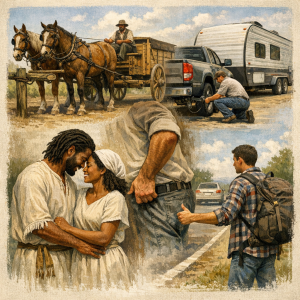
Primary Definition
Hitched is the past tense and past participle of hitch. Its central meaning is “fastened, attached, coupled, or joined,” usually in a manner that permits movement while maintaining a connection. A horse may be hitched to a post, a trailer may be hitched to a truck, clothing may be hitched up, and two persons may be described informally as having “got hitched,” meaning that they married.
The word has several related senses, all growing from the practical idea of a connection, pull, jerk, or temporary fastening:
- Physically attached: “The wagon was hitched to two horses.”
- Connected for towing or work: “The trailer was properly hitched to the vehicle.”
- Raised or adjusted with a quick pull: “He hitched up his trousers.”
- Moved with a jerk, limp, or uneven motion: “She hitched herself forward in the chair.”
- Obtained transportation informally: “They hitched a ride home.”
- Married, in informal speech: “The couple got hitched.”
As an adjective-like participle, hitched describes the completed condition of being connected: a hitched team, a hitched trailer, or, colloquially, a hitched couple. Context determines whether the word concerns transportation, clothing, bodily movement, military service, marriage, or some other kind of attachment.
Dictionary usage recognizes both the literal and figurative branches of the term. Merriam-Webster defines hitch broadly as moving by jerks, fastening or connecting, joining in marriage, and hitchhiking; it also recognizes a hitch as a fastening, an obstacle, a limp, or a period of military service. ([merriam-webster.com](https://www.merriam-webster.com/dictionary/hitch?utm_source=openai))
Etymology and Origin
Hitch appears in Middle English as hytchen, with recorded use beginning in the fifteenth century. Its earliest core sense concerned a jerk, pull, uneven movement, or fastening. The precise deeper origin is uncertain. Oxford’s learner’s dictionary describes the word’s Middle English origin as unknown, while Merriam-Webster likewise traces the English form to Middle English rather than confidently assigning it to a particular ancient language. ([merriam-webster.com](https://www.merriam-webster.com/dictionary/hitch?utm_source=openai))
This uncertainty matters. It is not sound etymology to claim that hitch has a proven Roman, Greek, biblical Hebrew, pagan, ecclesiastical, military, or governmental origin merely because the word later appeared in those settings. The documented history supports an English and probably dialectal development, but not a settled ancient derivation.
Some etymologists have considered whether hitch belongs to a family of words associated with shaking, jerking, or uneven movement, including forms resembling hotch and hatch. Such comparisons are proposals rather than settled proof. The practical senses of catching, fastening, coupling, and moving with a jerk are nevertheless easy to see as historically related: a hitch is both the pull that checks movement and the attachment that holds one thing to another.
The marital sense is considerably later than the basic physical sense. Etymological reference material dates the informal sense “to marry” to the mid-nineteenth century, with an 1844 record. The expression likely draws on the image of two animals or vehicles being coupled for a common course. That image explains the idiom, but it does not mean marriage is legally equivalent to ownership, livestock, or equipment. It is a colloquial metaphor, not a legal definition of the marital relationship. ([etymonline.com](https://www.etymonline.com/word/hitch?utm_source=openai))
Cultural and Historical Context
Work, Travel, and Temporary Fastening
Before the automobile, hitching was a familiar part of daily agricultural, commercial, and domestic life. Horses, mules, oxen, wagons, plows, and carriages had to be connected securely to perform work or travel safely. A person could hitch an animal to a rail, hitch a team to a wagon, or use a hitch knot to make a temporary but dependable fastening. The word therefore developed in the ordinary world of rope, harness, animal power, and transport.
A hitch may be deliberately temporary. A rope hitch is generally intended to secure a line while preserving the possibility of quick release or adjustment. This distinguishes it from every permanent fastening. In maritime, climbing, camping, ranching, and cargo-handling contexts, particular hitches are named according to their structure or use, such as a half hitch, clove hitch, or timber hitch. The word in those contexts concerns a method of fastening, not necessarily a knot in the strictest technical sense.
Obstruction and Delay
The noun sense of hitch as a snag, difficulty, interruption, or unexpected problem also grows naturally from the idea of movement being checked. A plan that proceeds “without a hitch” proceeds without a catch, delay, or impediment. Conversely, “there is a hitch” means that some condition prevents smooth completion.
This sense is now common in business, technology, politics, administration, and everyday conversation. It need not imply bad faith. A hitch may be a missing document, a technical incompatibility, a scheduling conflict, a safety issue, or an unanticipated contractual condition. The expression describes a practical impediment; it does not itself identify who is responsible for it.
Marriage and Popular Speech
“Get hitched” became a casual, often humorous American English expression for marrying. It is less formal than wed, marry, or enter into marriage. It may communicate warmth and informality, especially in invitations, announcements, entertainment writing, and conversation: “They finally got hitched.”
The expression can also carry different tones depending on speaker and setting. It may be celebratory, playful, rustic, irreverent, or mildly cynical. Because the metaphor comes from coupling or fastening, some people dislike it as overly mechanical or as suggesting that marriage is a restraint. Others use it without any negative implication. Tone is supplied by context, not fixed in the word itself.
Biblical / Torah Context
Hitched is an English word, not a Hebrew, Aramaic, or Greek term from the biblical manuscripts. Therefore, it should not be presented as though it carries an original Torah or biblical legal meaning. When English Bible translations use “hitch,” they are choosing an English expression to convey the practical act of harnessing or attaching animals to a vehicle.
A notable example appears in Micah 1:13. Some modern English translations render the command to the inhabitants of Lachish as “hitch the horses to the chariot.” The underlying setting is one of ancient military mobility and judgment imagery. The verse does not establish a religious doctrine about the English word hitch; rather, the translation uses a familiar English verb for preparing horses and chariots for movement. ([biblegateway.com](https://www.biblegateway.com/passage/?search=Micah+1%3A13-15&version=NET%3BESV%3BKJV%3BNKJV&utm_source=openai))
More broadly, Scripture frequently uses yokes, teams, cords, harnesses, chariots, and binding imagery. These images can communicate labor, burden, discipline, partnership, captivity, covenant, or military readiness, depending on the passage. A responsible reader should not collapse all such images into one meaning. A yoke is not identical to a hitch, and a covenant is not simply a physical attachment. The English word can be useful as a descriptive translation in a narrow transportation context, but its modern idioms should not be read back into ancient texts.
Nor is “getting hitched” a biblical phrase for marriage. Biblical discussions of marriage employ their own linguistic, legal, familial, and covenantal frameworks. The informal English idiom may be used by modern believers, but it has no independent scriptural authority and should not replace careful reading of the relevant passages.
Legal Implications
Common Law and Marriage
Hitched is not, by itself, a technical term of art in historical common law, modern statutory law, equity, Roman law, or constitutional law. In legal writing, its marital sense is ordinarily informal. A court order, marriage record, statute, license, or contract is more likely to use married, marriage, spouse, or another defined term.
Historically, English common law addressed marriage through doctrines concerning consent, capacity, prohibited degrees of relationship, legitimacy, property, ecclesiastical jurisdiction, and later civil regulation. Those doctrines varied over time and were not created by the slang expression “get hitched.” Modern marriage law in the United States is primarily governed by state and territorial law, including rules concerning licenses, solemnization, registration, divorce, inheritance, parental rights, and related matters.
In ordinary American administrative practice, a marriage license authorizes a marriage under the applicable jurisdiction’s process, while a marriage certificate documents that the marriage occurred. Requirements, expiration periods, officiant rules, waiting periods, and record procedures vary by jurisdiction. Saying that two people “got hitched” does not prove a legally valid marriage; legal status depends on the governing law and the relevant facts and records. ([usa.gov](https://www.usa.gov/marriage-certificate?utm_source=openai))
The same caution applies to disputed claims about “common-law marriage.” A couple does not become legally married merely because they describe themselves as hitched, live together, exchange rings, or use a shared surname. Whether any jurisdiction recognizes a non-ceremonial marriage, and under what conditions, is a question of that jurisdiction’s current law. Informal language is not a substitute for legal elements or evidence.
Vehicles, Towing, and Safety
In transportation law and safety practice, a hitch is a real mechanical connection with serious consequences. A trailer hitch, pintle hook, ball coupling, fifth wheel, kingpin connection, tow bar, or comparable coupling device must be appropriate for the equipment and load. “Hitched” in this setting means more than merely placed near or loosely connected to a towing vehicle; it implies that the coupling has been secured for operation.
Federal motor-carrier safety regulations require coupling devices for covered commercial operations to be properly designed, constructed, installed, and secured. For full trailers, the governing regulation requires a structurally adequate tow bar, adequate articulation without excessive slack, a locking device against accidental separation, and safety devices intended to prevent the trailer from breaking loose if the tow bar fails or disconnects. ([law.cornell.edu](https://www.law.cornell.edu/cfr/text/49/393.70?utm_source=openai))
Federal rules also require drivers of commercial motor vehicles to ensure that coupling devices are in good working order before operation. State laws may impose additional or different requirements for passenger vehicles, farm equipment, utility trailers, and recreational trailers. Texas, for example, specifies circumstances in which safety chains must be used and attached securely. The applicable rule always depends on the vehicle, use, jurisdiction, and current regulation. ([law.cornell.edu](https://www.law.cornell.edu/cfr/text/49/392.7?utm_source=openai))
Thus, a person may accurately say a trailer is “hitched,” yet the legal and safety question remains whether it is correctly hitched: compatible components, rated capacity, proper locking, electrical connection, breakaway equipment where required, safety chains or cables where required, and compliance with inspection and operating rules. The word describes a condition; it does not establish compliance.
Military Usage
A related noun use appears in expressions such as “a four-year hitch in the Army” or “a hitch in the service.” Here, hitch means a period or term of service, especially military service. This is idiomatic speech, not ordinarily the formal language of enlistment law. Official records and statutes generally refer to enlistment, service obligation, term of service, assignment, discharge, extension, or reenlistment.
Accordingly, “he was hitched to the military” would be figurative and may sound imprecise or disrespectful depending on context. “He did a hitch in the military” is more conventional informal usage. The phrase does not imply involuntary servitude or alter the actual contractual, statutory, or constitutional status of military service.
Spiritual Meaning
The word has no single inherent spiritual meaning. Any spiritual application is interpretive rather than lexical. Because hitching involves connection, direction, shared movement, and the bearing of a load, speakers may use it metaphorically to discuss partnership, commitment, discipline, dependence, or the consequences of attaching oneself to a person, cause, habit, or belief.
In a religious setting, “hitched” may be used colloquially for marriage and may suggest two lives traveling together. That can be a useful illustration, but it should not be confused with a complete theology of marriage. Spiritual traditions that describe marriage as covenant, sacrament, vocation, mutual obligation, or family institution generally use language more precise than a casual transport metaphor.
A careful spiritual reading also recognizes the difference between healthy connection and improper attachment. The fact that something is “hitched” does not by itself make the connection good, lawful, wise, or enduring. The quality of the connection depends on its purpose, truthfulness, consent, responsibility, and effects.
Modern Usage
In present-day English, hitched remains flexible and widely understood. The most common modern uses include:
- Marriage: “They got hitched last spring.”
- Towing: “Make sure the boat is hitched securely.”
- Clothing: “She hitched up her backpack and continued walking.”
- Physical repositioning: “He hitched himself higher in the seat.”
- Hitchhiking: “They hitched across the state.”
- Temporary service: “She completed a hitch overseas.”
The word is generally informal except in practical mechanical language, where hitch is an ordinary technical noun. A towing manual may speak precisely of a hitch assembly, while a legal document would generally avoid “got hitched” in favor of “married.” The informal character of the marital sense should be considered when drafting formal notices, affidavits, contracts, court documents, genealogical records, or official correspondence.
Controversies / Criticisms
The principal controversy surrounding hitched concerns figurative marriage language. Critics sometimes object that it portrays spouses as animals, equipment, or persons trapped in an unwanted bond. Supporters and ordinary users generally understand it as a harmless idiom meaning “married.” Both reactions are matters of tone and cultural preference rather than competing dictionary definitions.
A second problem arises when metaphor is mistaken for law. Claims that “hitched” has a hidden legal status, that it automatically creates a contract, or that the word proves a special form of common-law marriage are unsupported by the ordinary history of the term. Legal consequences arise from applicable law, legally relevant acts, and evidence—not from using or refusing a colloquial expression.
Finally, unsourced etymological claims should be approached cautiously. The ultimate origin of hitch is uncertain, and that uncertainty should not be filled with invented links to ancient religions, Roman institutions, biblical law, or secret legal terminology. The reliable conclusion is modest: the word is documented in Middle English and developed a broad range of meanings connected with jerking, fastening, coupling, obstruction, travel, and informal marriage.
Conclusion
Hitched describes a completed attachment or connection. Its oldest and most concrete associations are with a jerk, pull, fastening, harness, or coupling. From those practical foundations, English developed figurative uses involving delay, temporary service, travel, bodily adjustment, and marriage.
In law, the term is usually descriptive rather than determinative. A trailer may be hitched but unsafe; two persons may say they are hitched but require legally sufficient proof of marriage; and a military “hitch” may describe service informally without replacing formal enlistment terminology. In biblical translation, the word may accurately describe harnessing horses, but it is not itself a biblical or Torah term. Its strongest meaning remains the simplest one: something has been joined to something else for movement, work, or a shared course.
Sources / Further Reading
- Merriam-Webster Dictionary, “Hitch”
- Oxford Advanced Learner’s Dictionary, “Hitch”
- Online Etymology Dictionary, “Hitch”
- Bible Gateway, Micah 1:13–15
- USA.gov, “How to Get a Copy of a Marriage Certificate or a Marriage License”
- Legal Information Institute, 49 C.F.R. § 393.70, “Coupling Devices and Towing Methods”
- Legal Information Institute, 49 C.F.R. § 392.7, “Equipment, Inspection and Use”
- Legal Information Institute, 37 Tex. Admin. Code § 21.5, “Standards for Safety Chains”