Demanding (adj)
Primary Definition
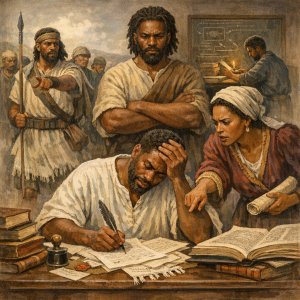
Demanding describes a person, duty, condition, undertaking, standard, or circumstance that requires a substantial amount of time, effort, skill, attention, endurance, patience, or compliance. A demanding task is not merely difficult in the abstract; it actively places significant requirements upon the person who must perform it. A demanding employer, customer, parent, commander, or institution expects much from others and may be difficult to satisfy.
The word has two closely related principal uses:
- Of work, circumstances, or things: requiring considerable exertion, ability, concentration, resources, or care. Examples include “a demanding profession,” “a demanding legal case,” “a physically demanding march,” and “a demanding course of study.”
- Of persons or groups: making frequent, high, exacting, or burdensome requests or expectations of others. Examples include “a demanding supervisor,” “a demanding client,” or “a demanding child.”
In ordinary usage, demanding may be neutral, favorable, or critical. Calling an examination demanding may praise its rigor. Calling a job demanding may acknowledge real responsibility and challenge. Calling a person demanding often carries a more critical suggestion: that the person expects more than is reasonable, considerate, agreed upon, or sustainable.
Modern dictionaries commonly define the adjective through the concepts of requiring much effort, time, skill, or attention, and, in reference to people, expecting much work or attention from others. Demanding is therefore related to exacting, arduous, taxing, rigorous, and challenging, but the words are not fully interchangeable. Challenging is frequently approving and emphasizes a test of ability; demanding emphasizes what is required or taken from the person meeting the challenge. ([merriam-webster.com](https://www.merriam-webster.com/dictionary/demanding?utm_source=openai))
Distinctions in Meaning
A useful distinction is between a demand and something that is demanding. A demand is an act of asking, claiming, requiring, or calling for something. Something demanding is a thing or person that imposes high requirements. Thus, a creditor may make a demand for payment, while the process of meeting financial obligations may be demanding. The first is an act or claim; the second is a description of burden, rigor, or expectation.
The adjective should also not be confused with in demand. A worker who is “in demand” is sought after by others. A worker whose role is “demanding” must give much of himself or herself to the role. One expression concerns public desire; the other concerns the burden of performance.
Etymology and Origin
Demanding is the present-participial adjective formed from the verb demand. The deeper history of the word is therefore the history of demand, which entered English through Middle English forms such as demaunden and demande. English received it from Anglo-French and Old French demander, meaning to ask, request, inquire, or claim. Those forms in turn are associated with Medieval Latin demandare, and ultimately with Latin mandare, meaning to entrust, commit, hand over, or command. The same Latin family is reflected in English words such as mandate and command. ([merriam-webster.com](https://www.merriam-webster.com/dictionary/demand?utm_source=openai))
This word history matters because it shows that the original semantic field was broader than harsh insistence. To demand could involve asking a question, making an inquiry, communicating instructions, entrusting a task, claiming what was due, or requiring something by authority. Over time, English usage strongly developed the senses of insistence, entitlement, and necessity. A thing “demands” attention when it needs attention; a person “demands” payment when the person claims payment as owed; and a rule “demands” compliance when its terms make compliance obligatory.
As an adjective, demanding developed from the ongoing sense of “making demands” and later became firmly established in the extended sense of “requiring much.” Lexicographical dating is not entirely uniform: one source traces adjectival evidence to the nineteenth century, while Merriam-Webster records its first known use in its current principal sense in 1926. Such variation does not mean that the word’s origin is doubtful; it reflects differences in dictionaries’ surviving evidence, dating methods, and chosen senses. ([merriam-webster.com](https://www.merriam-webster.com/dictionary/demanding?utm_source=openai))
Cultural and Historical Context
In social life, the word has long been useful for judging the relationship between expectation and capacity. Human communities necessarily impose demands: families need care, farms need labor, trades need skill, governments need administration, and armies need discipline. Yet the adjective demanding permits an important further judgment: are the expectations proportionate to the person, purpose, agreement, and available resources?
Historically, the language of demand became especially prominent in commercial, governmental, and legal settings because debts, services, rights, duties, taxes, and official commands often required clear articulation. In ordinary social speech, however, the adjective became a way of describing the lived burden produced by those requirements. A demanding occupation might require long hours, physical strength, technical knowledge, emotional steadiness, or responsibility for others. A demanding relationship might require attention and loyalty, but it may also become unhealthy if it lacks reciprocity, boundaries, or respect.
In military and governmental contexts, demanding is properly used as a descriptive word rather than as the name of a special legal power. Military training, field operations, command responsibility, emergency service, and public administration may be physically, mentally, and morally demanding because they require discipline, readiness, accurate judgment, and sustained performance under pressure. The word itself did not originate as a uniquely military or governmental term. Its connection to those fields comes from their frequent use of commands, duties, standards, and conditions of service.
Culturally, the term often reflects changing expectations concerning labor and personal life. What one generation calls diligence, another may call overwork; what one household calls responsibility, another may experience as excessive pressure. The adjective therefore carries a contextual judgment. A demanding standard may be worthy where the task concerns safety, trust, competence, or justice. It may be unreasonable where it disregards human limits or imposes obligations without fair authority or consent.
Biblical / Torah Context
The English adjective demanding is not a technical Hebrew, Aramaic, or Greek biblical term. It should not be treated as though it names one single original-language concept throughout Scripture. Biblical translations use words such as ask, require, command, seek, claim, and call for according to context. Consequently, a responsible biblical study distinguishes the English word from the original-language terms and from the theological claims made about them.
Within the Torah, Deuteronomy 10:12 asks what the LORD requires of Israel and answers with a call to reverence, faithful conduct, love, and service. The passage presents divine requirements not as arbitrary human pressure but within the covenant relationship between God and Israel. Its immediate language is commonly translated “ask” or “require,” not “demanding”; nevertheless, it is relevant to the broader question of what rightful obligation means in a religious and moral order. ([sefaria.org](https://www.sefaria.org/Deuteronomy.10.12/?ven=english%7CThe+Contemporary+Torah%2C+Jewish+Publication+Society%2C+2006&vhe=hebrew%7CMiqra+according+to+the+Masorah&vside=Publicado_em_5784%2C_Saymon_Pires_da_Silva_%5Bpt%5D&with=Translations&utm_source=openai))
The prophetic text of Micah 6:8 similarly speaks of what the LORD requires: doing justice, loving loyalty or kindness, and walking humbly with God. In context, the verse rejects the idea that extravagant religious offerings can substitute for moral faithfulness. It is therefore a useful corrective to an abusive understanding of demand. The biblical concern is not mere external burden or the multiplication of demands; it is justice, mercy, humility, and faithful conduct. ([sefaria.org](https://www.sefaria.org/Micah.6.8?lang=en&with=Translations&utm_source=openai))
From a Jewish and Christian interpretive perspective, these texts support the proposition that legitimate moral requirements must be understood alongside justice, compassion, humility, and covenantal responsibility. That is an interpretive application, not a dictionary definition. It does not establish that every difficult requirement made by a religious authority is divinely authorized. On the contrary, biblical ethical teaching supplies grounds for evaluating whether a purported requirement is righteous, merciful, truthful, and within proper authority.
Legal Implications
In legal language, the noun and verb demand have specialized meanings, but demanding ordinarily remains descriptive rather than technical. A lawyer may describe litigation as demanding, a contractual obligation as demanding, or a regulatory scheme as demanding. Those statements communicate complexity or burden; they do not, by themselves, create a legal duty, establish jurisdiction, prove a claim, or identify a remedy.
A legal demand may be a formal request or call for performance, often based on an asserted legal right. For example, a written demand for payment may request payment of an alleged debt. Whether the recipient must pay depends not on forceful wording alone, but on a valid obligation under the relevant contract, statute, judgment, or other body of law. A demand letter is not automatically a court order, and receiving one does not itself establish liability.
At common law, formal demands could matter in particular actions and procedures, especially where a claimant needed to request performance, possession, or payment before treating another party as in default. The details varied by cause of action and jurisdiction. Modern American law is not one undifferentiated body of “common law”: it includes constitutions, statutes, administrative regulations, procedural rules, equitable doctrines, and case law. Whether a pre-suit demand is required today depends on the applicable jurisdiction and the particular claim.
Federal procedural law provides clear examples of the technical use of demand. Under Rule 38 of the Federal Rules of Civil Procedure, a party may demand a jury trial on an issue triable by jury, generally by serving and filing a written demand within the prescribed period. Failure to make a proper timely demand may waive a jury trial under that rule. This is a procedural requirement, not evidence that every assertion styled a “demand” has legal force. ([law.cornell.edu](https://www.law.cornell.edu/rules/frcp/rule_38?utm_source=openai))
Commercial law supplies another distinct example. Under Uniform Commercial Code Article 3, an instrument is “payable on demand” when it states that it is payable on demand or at sight, indicates payment at the holder’s will, or states no time for payment. A presentment is, in part, a demand made by a person entitled to enforce the instrument for payment or acceptance. These are defined commercial-law concepts; their meaning derives from the enacted or adopted UCC provisions in the relevant jurisdiction, not from everyday dictionary usage alone. ([law.cornell.edu](https://www.law.cornell.edu/ucc/3/3-108?utm_source=openai))
Accordingly, it is inaccurate to argue that the ordinary adjective demanding, or the mere use of the word demand in correspondence, automatically transforms a private statement into law. Law depends upon authority, facts, procedure, jurisdiction, and the governing legal rule. The word may signal a claim of right, but it cannot manufacture a right that does not otherwise exist.
Spiritual Meaning
Spiritually, demanding often concerns discernment about obligation, discipline, sacrifice, and limits. A demanding spiritual practice may involve regular prayer, study, fasting, service, repentance, charitable giving, or the patient development of virtue. In that sense, demanding does not necessarily mean harmful. Many disciplines require consistent effort precisely because they aim at moral formation rather than immediate comfort.
At the same time, spiritual language can be misused to excuse coercion. A leader, community, or family should not employ claims of divine authority to impose unreasonable control, silence conscience, exploit labor, or evade accountability. The distinction between a challenging discipline and an abusive demand includes such questions as: Is the requirement truthful? Is it proportionate? Is it applied fairly? Is consent meaningful? Does it honor human dignity? Does it serve justice and love rather than pride, fear, or domination?
The dictionary’s interpretive analysis is that a spiritually sound understanding of demanding obligation holds two truths together: worthy commitments may require sacrifice, and no human authority is made righteous merely by making forceful demands. Difficulty alone is not proof of spiritual value, nor is comfort alone proof of freedom.
Modern Usage
Today, demanding is widely used in education, employment, health care, athletics, caregiving, technology, law, and personal relationships. It commonly appears with modifiers that specify the nature of the burden:
- Physically demanding: requiring strength, stamina, mobility, or bodily exertion.
- Mentally demanding: requiring concentration, judgment, memory, analysis, or sustained attention.
- Emotionally demanding: requiring empathy, restraint, resilience, or care amid stress or conflict.
- Technically demanding: requiring specialized knowledge, precision, or practiced skill.
- Legally demanding: requiring careful research, procedure, documentation, and analysis.
The word also remains common in interpersonal evaluation. “Demanding” may identify a person who has high standards, but it can imply impatience, entitlement, or disregard for another person’s limits. Speakers should therefore make the basis of the judgment clear. It is more informative to say that a supervisor expects after-hours responses without agreement, or that a project requires advanced precision under a short deadline, than simply to label a person or task demanding.
Controversies / Criticisms
The principal controversy surrounding the word is not etymological but evaluative. The same expectation may be called demanding, rigorous, disciplined, exploitative, ambitious, or responsible depending on the speaker’s position and values. Employers may describe high performance requirements as necessary for quality or public safety; workers may describe the same requirements as unreasonable if compensation, staffing, training, or working conditions are inadequate. Neither label alone resolves the underlying facts.
There is also a recurring risk of using the adjective as a vague criticism. Calling someone demanding can avoid the more precise work of identifying whether the actual problem is repeated interruption, unpaid labor, coercion, lack of reciprocity, poor communication, excessive deadlines, or violation of an agreement. Precision is especially important in legal, workplace, family, and religious settings, where generalized language can obscure rights and responsibilities.
Claims that the word itself has a hidden legal, ecclesiastical, Roman, military, or governmental meaning should be approached with caution. The documented etymology connects the word to French and Latin forms relating to asking, entrusting, ordering, and claiming; it does not support the proposition that the adjective demanding is secretly a technical status word or an independent source of legal authority. ([merriam-webster.com](https://www.merriam-webster.com/dictionary/demand?utm_source=openai))
Conclusion
Demanding is an adjective of requirement, burden, rigor, and expectation. It can describe a task that calls forth serious effort, a standard that requires excellence, or a person who expects much from others. Its meaning depends upon context: demanding may be a compliment when it identifies worthwhile challenge, or a criticism when it identifies excessive, unfair, or inconsiderate pressure.
Its legal relevance arises chiefly through the more technical word demand, which may refer to a formal request, claim, procedural act, or commercial-law event. The adjective itself does not create legal consequences. In ethical and spiritual reflection, the central question is not whether an obligation is demanding, but whether it is rightful, proportionate, humane, and directed toward justice, truth, and faithful responsibility.
Sources / Further Reading
- Merriam-Webster, “Demanding.” https://www.merriam-webster.com/dictionary/demanding
- Merriam-Webster, “Demand.” https://www.merriam-webster.com/dictionary/demand
- Oxford Learner’s Dictionaries, “Demanding.” https://www.oxfordlearnersdictionaries.com/definition/english/demanding
- Online Etymology Dictionary, “Demanding.” https://www.etymonline.com/word/demanding
- Legal Information Institute, Cornell Law School, Federal Rule of Civil Procedure 38. https://www.law.cornell.edu/rules/frcp/rule_38
- Legal Information Institute, Cornell Law School, Uniform Commercial Code § 3-108. https://www.law.cornell.edu/ucc/3/3-108
- Sefaria, Deuteronomy 10:12. https://www.sefaria.org/Deuteronomy.10.12/
- Sefaria, Micah 6:8. https://www.sefaria.org/Micah.6.8?lang=en&with=Translations