At and In,
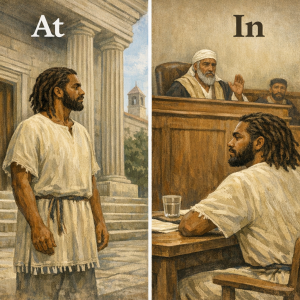
Primary Definition
At and in are English prepositions used to express relationships of place, time, condition, activity, association, or legal setting. Although their meanings overlap, they ordinarily present location from different perspectives:
- At commonly identifies a point, station, event, address, activity, or general location without necessarily declaring physical enclosure: at the door, at the courthouse, at noon, at trial, or at law.
- In commonly identifies inclusion within boundaries, limits, circumstances, an institution, a condition, or a field of activity: in the room, in the county, in custody, in court, or in equity.
The distinction may be physical, conceptual, or merely idiomatic. A person may be at the courthouse while standing outside it, in the courthouse while physically inside, at court while attending judicial business, and in court while participating in a proceeding. Context, established usage, and the governing legal text determine which meaning applies.
These prepositions may carry important consequences when they form part of a statute, contract, deed, order, indictment, or jurisdictional provision. Nevertheless, neither word is independently a legal act. Saying in does not, by itself, create jurisdiction, ownership, contractual submission, or governmental authority; saying at does not, by itself, defeat those things. Their significance arises from the complete expression in which they appear.
Etymology and Origin
At descends from Old English æt, related to forms in Old Norse, Gothic, Old Frisian, and Old High German. Its remote Indo-European root conveyed the ideas of “to,” “near,” or “at.” The word’s earliest force was therefore relational: it placed one person or object beside, toward, or in connection with another point. Over time it acquired temporal, occupational, directional, and abstract uses, including at night, at work, at peace, and attorney at law. ([etymonline.com](https://www.etymonline.com/word/at?utm_source=openai))
In is likewise inherited from the Germanic ancestry of English. Cognate forms occur in Old Frisian, Old Saxon, Old High German, Gothic, and Old Norse. Its central historical meaning is inclusion or position within spatial, temporal, or conceptual limits. Earlier Germanic usage did not always preserve the modern distinction among in, on, and into. In parts of Old English, on could perform work now assigned to in, while motion into a place could be conveyed by in together with the governing verb. The modern compound into eventually made the direction-versus-position distinction clearer. ([ca1.uscourts.gov](https://www.ca1.uscourts.gov/sites/ca1/files/citations/in%2C%20prep.1%20_%20Oxford%20English%20Dictionary.pdf))
Latin influenced English legal and ecclesiastical writing, particularly because Latin in could express position or motion according to grammatical case. This influence broadened some English uses, but there is no documented basis for claiming that the ordinary English contrast between the two words originated as a secret Roman jurisdictional formula.
Cultural and Historical Context
English speakers frequently move between a “point” conception and a “container” conception of place. A village may be treated as a point on a journey—we stopped at York—or as an area containing people and buildings—we lived in York. Neither form necessarily contradicts the other. The speaker has selected a different perspective.
Social function also affects usage. A worshipper may be at church, emphasizing attendance at worship, while a visitor examining the architecture is in the church. A pupil may be at school, meaning engaged in schooling, even while standing on the playground. American and British customs sometimes differ: forms such as in school and at school may refer either to institutional participation or to physical location.
Historical legal English contains the same flexibility. Alexander Burrill’s nineteenth-century Law Dictionary and Glossary observed that the old title apprentice at law also appeared as apprentice in law, and that attorney at law could occasionally be rendered attorney in law to distinguish the office from an attorney in fact. Burrill suggested that both prepositions had, in those expressions, a sense resembling “for.” ([ndconst.org](https://ndconst.org/_media/dict/1867_burrill_vol_1.pdf?utm_source=openai))
Military and governmental language also illustrates function rather than hidden status. A service member may be in the Army, at a base, in barracks, at sea, or in a vessel. Command authority arises from lawful military status, orders, territorial authority, and applicable legislation—not from the isolated preposition selected to describe the member’s location.
Biblical / Torah Context
Biblical Hebrew cautions against assigning a rigid metaphysical significance to the English distinction. The prefixed Hebrew preposition בְּ (bĕ-) can be translated as in, at, by, with, among, or another relational expression according to context. Biblical prepositions are highly flexible, and a lexicon supplies a range of possible senses rather than a mechanical replacement applicable to every verse. ([betheden-hebrew-grammar.readthedocs.io](https://betheden-hebrew-grammar.readthedocs.io/en/latest/preposition.html?utm_source=openai))
Deuteronomy 6:7 provides a simple example. English translations variously describe speaking of the commandments while sitting “in your house,” “at home,” or “in thine house.” The underlying teaching concerns continual instruction in ordinary life; the theological force does not depend on choosing the English word at rather than in. ([biblegateway.com](https://www.biblegateway.com/verse/en/Deuteronomy%206%3A7?utm_source=openai))
Scripture certainly uses enclosure and presence as meaningful images: dwelling in a house, abiding in covenant, standing at a gate, being in exile, or appearing at an appointed place. Those images should be interpreted from the passage, language, and covenantal setting. It would be unsound to build a universal doctrine of jurisdiction or spiritual submission upon an English preposition when the source language may use one form for several English relations.
Legal Implications
Legal Texts and Contextual Interpretation
Prepositions can be legally consequential when the legislature or contracting parties use them to define a boundary. A law applicable to conduct in a school may raise the question whether the conduct must occur inside the building, anywhere on school property, or within an educational program. A contract requiring suit in New York may present a different venue issue from one requiring suit in the courts of New York. Courts therefore read the disputed word together with the noun it governs, the surrounding provisions, the instrument’s purpose, and recognized usage.
The Supreme Court has treated statutory expressions such as “within the jurisdiction” according to their natural meaning and statutory function. In United States v. Rodgers, the Court explained that a matter is within an agency’s jurisdiction when it falls within the authority lawfully entrusted to that agency. The preposition helped form the statutory phrase, but the agency’s authority came from law, not from the word alone. ([law.cornell.edu](https://www.law.cornell.edu/supremecourt/text/466/475?utm_source=openai))
Modern statutory disputes confirm that in is not invariably limited to literal enclosure. Depending on context, “arriving in,” acting “in commerce,” or filing “in” a court may describe a legal relationship broader than bodily presence inside a boundary. Courts may examine ordinary meaning, related provisions, established terms of art, and the practical operation of the entire statutory scheme.
Common Law, Law, and Equity
The traditional expressions at law and in equity arose from the historical separation of English common-law courts and the Court of Chancery. An “action at law” generally sought remedies recognized in the common-law courts, especially damages, while a “suit in equity” sought equitable relief such as an injunction, specific performance, rescission, or reformation.
These expressions became terms of art. Their prepositions help identify legal classifications, but they did not create the underlying institutions. Equity did not acquire authority because a pleading used in, nor did a claim become a valid common-law action merely because it was described as at law. The nature of the right, remedy, forum, and governing procedure controlled.
The federal system largely merged the procedure of law and equity in 1938, although distinctions between legal and equitable rights and remedies remain important, particularly for jury-trial questions and the availability of equitable relief.
Jurisdiction Is Not Created by a Preposition
Jurisdiction concerns a tribunal’s lawful power to hear and decide a matter. It may involve subject-matter jurisdiction, personal jurisdiction, territorial authority, jurisdiction over property, and authority to grant a requested remedy. These forms of power arise from constitutions, statutes, service of process, legally sufficient contacts, control over property, consent where consent is permitted, and procedural rules. ([law.cornell.edu](https://www.law.cornell.edu/wex/jurisdiction?utm_source=openai))
Physical presence can be legally relevant. Service of process upon a person voluntarily present within a state may, subject to applicable law and recognized exceptions, establish personal jurisdiction. Participation in litigation without timely objection can also waive a personal-jurisdiction defense. But these consequences arise from service, presence, conduct, waiver, and procedural law—not because a judge or litigant used the expression in court. ([law.cornell.edu](https://www.law.cornell.edu/wex/personal_jurisdiction?utm_source=openai))
Subject-matter jurisdiction is different. Parties generally cannot create it by consent, silence, agreement, appearance, or verbal formula. A federal court lacking constitutional or statutory power over a category of case must dismiss, regardless of whether every party declares that the case is “in” that court. The Supreme Court describes subject-matter jurisdiction as the court’s statutory or constitutional power to adjudicate the case. ([law.cornell.edu](https://www.law.cornell.edu/supremecourt/text/01-687?utm_source=openai))
Accordingly, a statement such as “I am at the courthouse, not in the court” does not ordinarily defeat a pending proceeding. It may accurately distinguish physical locations, but it does not answer whether process was validly served, whether the person is a party, whether the tribunal has subject-matter jurisdiction, or whether an objection was properly and timely preserved.
Vehicles, Vessels, Property, and Private Rules
A person inside a privately owned car, ship, building, or fenced estate does not become subject to every command of the owner merely because the person is described as being in it. An owner’s authority depends upon property law, contract, consent, licensing conditions, maritime law, employment relations, and public law. An owner may impose lawful conditions for entry or continued presence, but cannot manufacture unlimited governmental jurisdiction through grammar.
Likewise, a person at a port may still be subject to customs, immigration, security, or maritime regulations, while a person in a vessel may remain governed by territorial law, flag-state law, contractual duties, or criminal statutes. The controlling legal relationships must be identified rather than inferred from the preposition alone.
Spiritual Meaning
As spiritual symbols, the two words can represent different degrees of relationship. To stand at a threshold suggests nearness, readiness, invitation, observation, or decision. To be in a house, covenant, community, or state of peace suggests participation, indwelling, inclusion, or commitment.
This symbolic distinction can be useful in teaching and meditation, but it is interpretive rather than a universal rule of language. A person may be physically inside a sacred building without spiritual commitment, while another may stand outside yet remain deeply faithful. Spiritual belonging cannot be conclusively determined by physical enclosure or grammatical form.
Modern Usage
In contemporary speech, at commonly marks a point or activity, while in marks an area, enclosure, condition, or membership:
- at 100 Main Street, but in the building;
- at the conference, but in the meeting room;
- at the border, but in the country;
- at work, but in employment;
- at liberty, but in custody;
- at trial, but in litigation;
- at sea, but in territorial waters.
The contrast remains flexible. “She is at the hospital” may mean that the hospital is her relevant location, while “she is in the hospital” often implies physical presence inside and, in some dialects, admission as a patient. “He is at the university” may refer to attendance or employment, while “he is in the university” may emphasize membership, enrollment, or location within the grounds.
Digital communication has added further uses. The at-sign identifies addresses, accounts, and online handles, while users may be described as being in a virtual meeting, chat room, database, or network. These newer uses continue the older distinction between connection to a point and inclusion within a defined environment.
Controversies / Criticisms
Some alternative legal writings assign absolute jurisdictional significance to these words. One version claims that being “in” a court, vehicle, country, or organization necessarily places a person under its complete authority, whereas being merely “at” that place preserves independence. This proposition contains a limited linguistic insight—in often conveys inclusion—but extends it beyond what grammar and law support.
The principal objections are:
- Language is contextual. Both words possess numerous spatial, temporal, institutional, and figurative meanings.
- Legal authority requires a legal source. Constitutions, statutes, jurisdictional facts, lawful process, and recognized forms of consent cannot be replaced by wordplay.
- Descriptions are not necessarily operative acts. Describing someone as “in court” does not establish that service was valid or that the court possesses subject-matter jurisdiction.
- Translation defeats rigid formulas. A single Hebrew, Latin, or other source-language preposition may be translated by several English words.
- Historical legal expressions are conventional. Phrases such as at law, in equity, and in the Supreme Court developed as terms of art, not as concealed declarations of personal submission.
This does not make prepositions legally irrelevant. Courts sometimes decide major cases by carefully construing short relational words. The error lies not in examining them, but in isolating them from syntax, context, legal history, and the source of authority. Precision is valuable; talismanic interpretation is not.
Conclusion
The distinction between at and in is fundamentally one of relationship and perspective. The first often treats a place, time, event, or activity as a point of connection; the second often treats it as a boundary, condition, institution, or sphere of inclusion. Their meanings overlap and have changed through centuries of ordinary, biblical, governmental, military, and legal usage.
In law, either word may contribute to the meaning of a controlling text, but neither independently creates or destroys jurisdiction. Sound interpretation begins with the actual words and then proceeds to context, history, legal classification, procedure, and the authority from which the rule derives.
Sources / Further Reading
- Oxford English Dictionary, “In, prep.” — https://www.ca1.uscourts.gov/sites/ca1/files/citations/in%2C%20prep.1%20_%20Oxford%20English%20Dictionary.pdf
- Online Etymology Dictionary, “At” — https://www.etymonline.com/word/at
- Alexander M. Burrill, A Law Dictionary and Glossary — https://ndconst.org/_media/dict/1867_burrill_vol_1.pdf
- United States v. Rodgers, 466 U.S. 475 (1984) — https://www.law.cornell.edu/supremecourt/text/466/475
- United States v. Cotton, 535 U.S. 625 (2002) — https://www.law.cornell.edu/supremecourt/text/01-687
- Federal Rule of Civil Procedure 4 — https://www.law.cornell.edu/rules/frcp/rule_4
- Federal Rule of Civil Procedure 12 — https://www.law.cornell.edu/rules/frcp/rule_12
- Constitution Annotated, Due Process and Personal Jurisdiction — https://www.law.cornell.edu/constitution-conan/amendment-5/due-process-and-personal-jurisdiction-doctrine-and-practice
- University of Texas, Biblical Hebrew Grammar for Beginners: Prepositions — https://hebrew.laits.utexas.edu/drupal/themes/hebrewgrid/bh/bhonline/grammar/prepositions.pdf