Vero ea et omnis impedit.
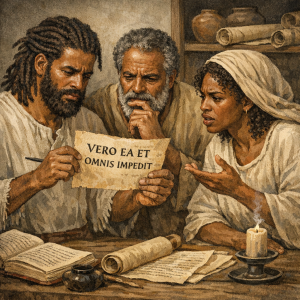
Primary Definition
The supplied wording is not a recognized English common-law term, Latin legal maxim, biblical expression, military formula, governmental designation, or established phrase in classical Latin literature. It should therefore not be treated as carrying an independent technical definition. Rather, it appears to be a short, malformed, or machine-generated Latin-like string composed of ordinary Latin words or word-forms.
Dictionary analysis must distinguish a genuine expression from a collection of individually recognizable words. Here, the individual components can be identified, but their combination does not produce a settled or reliable proposition. The first component, vero, may mean “truly,” “indeed,” “certainly,” “but,” or “however,” depending on context. Ea can be a form of the demonstrative pronoun is, ea, id, meaning “she,” “it,” “that,” “those things,” or “by/with those things,” according to gender, number, and case. Et ordinarily means “and.” Omnis means “every,” “each,” “all,” or “the whole,” but ordinarily requires a noun or another grammatical element with which to agree. Impedit is commonly the third-person singular present form of impedire, meaning “hinders,” “obstructs,” “entangles,” or “prevents.”
Because these forms do not agree or connect in a clear classical construction, no definitive translation should be assigned. At most, the wording suggests fragments concerning truth, a thing or person, totality, and obstruction. That suggestion is interpretive only; it is not a legally operative meaning, a moral command, or a statement of doctrine.
A careful reader should resist a frequent error in pseudo-legal and internet-based Latin interpretation: the assumption that words which appear ancient, foreign, or formal necessarily create an enforceable maxim. Meaning arises from grammar, context, usage, and authority—not from the appearance of Latin vocabulary alone.
Etymology and Origin
Word-Level Origins
Vero derives from verus, “true.” In Latin prose it often operates not simply as a descriptive word but as a discourse particle. It may strengthen an assertion (“indeed,” “certainly”), mark contrast (“but,” “however”), or transition to a new point. Its precise force depends heavily on placement and surrounding clauses. Lewis’s Latin dictionary records these varied uses and shows that the word may function affirmatively, adversatively, or rhetorically. ([perseus.tufts.edu](https://www.perseus.tufts.edu/hopper/text?doc=Perseus%3Atext%3A1999.04.0060%3Aentry%3Dvero&utm_source=openai))
Ea belongs to the demonstrative pronoun is, ea, id. Latin pronouns are inflected: their forms change according to gender, number, and grammatical case. Thus, ea can be feminine singular nominative or ablative, or neuter plural nominative or accusative. Without a complete sentence, there is no sound basis for choosing among “she,” “that,” “those things,” or “by those things.” Classical grammatical tables confirm these multiple possible functions. ([perseus.tufts.edu](https://www.perseus.tufts.edu/hopper/text?doc=Perseus%3Atext%3A1999.04.0001%3Apart%3D1%3Asection%3D21&utm_source=openai))
Et is the ordinary Latin conjunction “and.” Although simple in itself, it creates a grammatical expectation: it generally joins comparable words, phrases, or clauses. In the supplied sequence, the material on either side of the conjunction does not plainly form a coordinated pair.
Omnis is an adjective meaning “every,” “each,” “all,” or “whole.” It may refer to each member of a class, to all members collectively, or to the entirety of something. Its use normally requires agreement with a stated or implied noun. An isolated singular omnis, positioned beside an unrelated pronoun and a singular verb, leaves the reader unable to determine whether an omitted masculine or feminine noun was intended. Latin lexicographical sources record its wide range from “each” to “the whole.” ([elexicon.scriptores.pl](https://elexicon.scriptores.pl/en/lemma/OMNIS?utm_source=openai))
Impedit comes from impedire, conventionally translated “to hinder,” “to impede,” “to obstruct,” or “to entangle.” Its etymological association is commonly understood through the idea of entangling or fettering the feet. In ordinary prose it can describe a physical obstruction, an interference with action, or a figurative hindrance. Yet the presence of a verb meaning “hinders” does not itself establish who acts, what is hindered, or the nature of the alleged obstacle.
No Documented Phrase-Origin
There is no documented basis for attributing the supplied wording to Roman legislation, medieval canon law, English common law, the Magna Carta, admiralty practice, military orders, a biblical manuscript, rabbinic literature, or a recognized ecclesiastical text. A phrase may contain Latin vocabulary without being a quotation from an authoritative Latin source. In this instance, the absence of a stable grammatical reading is itself strong reason not to claim an ancient origin.
The wording may instead reflect the modern phenomenon of filler text, automated content generation, or an imperfect rearrangement of Latin-derived placeholder material. The most familiar example is Lorem ipsum, a typographical filler tradition derived, through alteration and extraction, from Cicero’s De finibus bonorum et malorum. Cicero’s actual passage is philosophical prose concerning pleasure, pain, error, and the human pursuit of the good; it is not a legal formula. ([perseus.tufts.edu](https://www.perseus.tufts.edu/hopper/text?doc=Perseus%3Atext%3A2007.01.0036%3Abook%3D1&utm_source=openai))
Cultural and Historical Context
Latin has long carried an appearance of learning, legal seriousness, religious authority, and historical continuity in English-speaking societies. That cultural prestige explains why Latin fragments are often displayed on seals, certificates, court-related materials, university insignia, military insignia, and religious objects. But prestige is not proof of meaning. A phrase must still be grammatically intelligible and traceable to a source before it can be accurately translated or relied upon.
Classical Latin was a living language of Roman administration, literature, rhetoric, philosophy, and law. Later forms of Latin served as important written languages in medieval Europe, the Roman Catholic Church, universities, diplomacy, science, and legal records. Those historical uses produced many genuine maxims and formulas. Examples include expressions used in Roman law, canon law, and later common-law writing. Their authority, however, comes from their identifiable textual history and judicial or scholarly use—not merely from their being in Latin.
The present wording should not be placed among those established maxims. Its vocabulary is broadly Latin, but its arrangement lacks the syntactic completeness expected of a quotation, legal rule, or literary sentence. The responsible historical conclusion is negative but important: no documented cultural tradition attaches a distinct meaning to it.
Where it occurs in a modern document, webpage, image, form, or template, the surrounding material should be examined. It may indicate unfinished drafting, sample text, content-generation error, transcription error, or decorative pseudo-Latin. Context may reveal a practical purpose for its appearance, but context cannot transform an ungrammatical fragment into binding language.
Biblical / Torah Context
No reliable basis exists for identifying the supplied wording as a quotation from the Hebrew Bible, the Torah, the Greek Septuagint, the Latin Vulgate, the New Testament, or traditional Jewish legal literature. The Hebrew Bible was principally composed in Hebrew, with portions in Aramaic; the New Testament was composed in Greek. Latin biblical wording belongs chiefly to later translations and Western Christian transmission, especially the Vulgate tradition.
Individual Latin words such as omnis and forms of impedire can of course appear in Latin Christian writing, just as words such as “all,” “true,” and “hinder” appear in English scripture. That fact does not establish that this particular wording is scriptural. A genuine biblical attribution requires a book, chapter, verse, language tradition, and text witness capable of verification.
Accordingly, no theological doctrine, Torah principle, covenantal obligation, commandment, or biblical spiritual teaching should be derived from this expression. Any attempt to do so would be personal allegory rather than textual interpretation. Personal reflection may use words such as truth, totality, and impediment as themes, but it should be clearly labeled as reflection and not represented as the meaning of an ancient sacred text.
Legal Implications
Not a Common-Law Maxim
The supplied wording has no demonstrated standing as a maxim of English common law. Common law develops through judicial decisions, recognized legal principles, and the reasoning of courts. A Latin expression may sometimes summarize a legal principle, but the expression does not independently create the rule. The relevant question is always whether a competent legal authority—such as a constitution, statute, regulation, binding case, or applicable court rule—adopts the proposition.
There is likewise no basis to treat the wording as a rule of Roman law. Roman law had its own technical vocabulary, sources, and compilations; medieval and early-modern lawyers later borrowed some Roman formulations, often with changed meanings. A loose collection of Latin words is neither Roman law nor common law merely because it contains a verb related to obstruction.
“Impediment” in Modern Law
Modern law does use English terms such as “impediment,” “obstruction,” and “interference,” but their meanings depend on the jurisdiction and the legal subject. For example, a federal regulation may define “legal impediment” in the specific context of a prior marriage, the dissolution of a marriage, or a defect in a marriage ceremony. That specialized regulatory use does not supply a meaning for the supplied Latin wording. ([law.cornell.edu](https://www.law.cornell.edu/cfr/text/20/725.230?utm_source=openai))
Similarly, “interference” may be a term in tort, contract, property, employment, election, or criminal law. Legal consequences arise only when the elements of a particular claim, offense, defense, or statutory provision are met. ([law.cornell.edu](https://www.law.cornell.edu/wex/interference?utm_source=openai))
Therefore, this wording should not be inserted into pleadings, affidavits, contracts, notices, commercial instruments, or communications with a court as though it had self-executing force. Unexplained foreign-language material can create ambiguity and may distract from the actual legal issue. If a legal document must address an obstacle, prevention, delay, incapacity, interference, or legal impediment, it should use the controlling jurisdiction’s defined terminology and clearly state the relevant facts.
Governmental and Military Use
No verified governmental or military usage has been identified. Latin has historically appeared in military mottos and governmental seals, but a motto is not automatically an order, statute, regulation, or rule of engagement. Nor does the verb impedire create a military implication merely because physical obstruction can occur in warfare. No military interpretation should be inferred without a documented source.
Spiritual Meaning
There is no established spiritual meaning attached to the supplied wording. It is not known as a prayer, sacramental formula, liturgical response, devotional saying, mystical teaching, or religious legal principle. The dictionary’s interpretive analysis therefore declines to assign it an inherent sacred significance.
A reader may nonetheless observe that the separate word-level ideas can invite reflection: truth may call for honesty; “all” may suggest completeness or universality; hindrance may suggest an obstacle to action or growth. Such observations belong to personal meditation, homiletic application, or literary symbolism. They do not constitute a translation of the wording or evidence of divinely revealed content.
This distinction is especially important where spiritual language overlaps with legal language. Claims that a foreign phrase cancels obligations, defeats jurisdiction, establishes personal sovereignty, or supplies religious exemption require actual legal and factual support. Spiritual conviction may be sincerely held, but sincerity does not alter the grammar of a text or the operative law of a court.
Modern Usage
In modern usage, this wording is best classified as nonstandard Latin-like text. Its likely practical uses are accidental rather than technical: placeholder copy, unfinished website content, a generated text fragment, an OCR or transcription mistake, a machine-translation artifact, or decorative language selected for visual effect.
Its appearance should prompt verification rather than confident translation. A translator should locate the original document, identify the author or publisher, compare nearby text, and determine whether the phrase has been copied correctly. Where legal rights, religious claims, property interests, immigration matters, military records, or contractual duties are involved, a qualified translator or attorney should review the complete source in context.
Modern automated systems can generate grammatical-looking strings that are not grammatical Latin. Search engines, translation tools, and language models may also return overconfident translations when given fragments without context. The appropriate standard is not whether an English gloss can be imagined, but whether the original words form a coherent sentence according to the relevant form of Latin and whether a trustworthy source supports the attributed use.
Controversies / Criticisms
The chief controversy surrounding Latin-like expressions of this kind is interpretive overreach. One person may offer a smooth English translation by silently changing cases, supplying missing nouns, disregarding agreement, or treating an isolated conjunction as though it were connected to an omitted clause. Another may attach legal, religious, political, or historical claims to the result. Such translations may sound plausible while lacking textual support.
A second concern is false authority. Latin can be used rhetorically to make a claim appear older or more formal than it is. In legal settings, this may encourage the mistaken belief that an ancient formula overrides statutes, court rules, or precedent. In religious settings, it may encourage unsupported claims of scriptural or ecclesiastical origin. Neither result follows from the wording itself.
A third concern is the conflation of related vocabulary with a recognized doctrine. The English words “impediment” and “interference” have real legal applications; Latin words related to hindering have real classical meanings. But related vocabulary does not establish that this particular sequence is a legal term. The distinction between a word, a phrase, a maxim, and a legally enforceable rule must be maintained.
Conclusion
The supplied wording has no verified status as a common-law doctrine, Roman-law maxim, biblical quotation, military order, governmental formula, or spiritual teaching. Its individual components derive from recognizable Latin vocabulary, but the sequence does not form a clear, standard Latin proposition and cannot responsibly be given one fixed translation.
The sound dictionary conclusion is that it is a nonstandard and likely malformed Latin-like expression. Any asserted legal, historical, biblical, or spiritual significance remains unproven unless a reliable primary source and a complete contextual reading are supplied. Where accuracy matters, the proper course is to preserve the original source, verify the text, and rely on qualified linguistic or legal analysis rather than on the appearance of antiquity.
Sources / Further Reading
- Perseus Digital Library, Charlton T. Lewis, An Elementary Latin Dictionary, entry for vero: https://www.perseus.tufts.edu/hopper/text?doc=Perseus%3Atext%3A1999.04.0060%3Aentry%3Dvero
- Perseus Digital Library, Allen and Greenough, New Latin Grammar, pronoun forms for is, ea, id: https://www.perseus.tufts.edu/hopper/text?doc=Perseus%3Atext%3A1999.04.0001%3Apart%3D1%3Asection%3D21
- Perseus Digital Library, Cicero, De finibus bonorum et malorum, Book I: https://www.perseus.tufts.edu/hopper/text?doc=Perseus%3Atext%3A2007.01.0036%3Abook%3D1
- Scaife ATLAS / Perseus, Lewis and Short Latin Dictionary resources: https://atlas.perseus.tufts.edu/
- Legal Information Institute, Cornell Law School, 20 C.F.R. § 725.230, “Legal impediment”: https://www.law.cornell.edu/cfr/text/20/725.230
- Legal Information Institute, Cornell Law School, “Interference” overview: https://www.law.cornell.edu/wex/interference